In brief
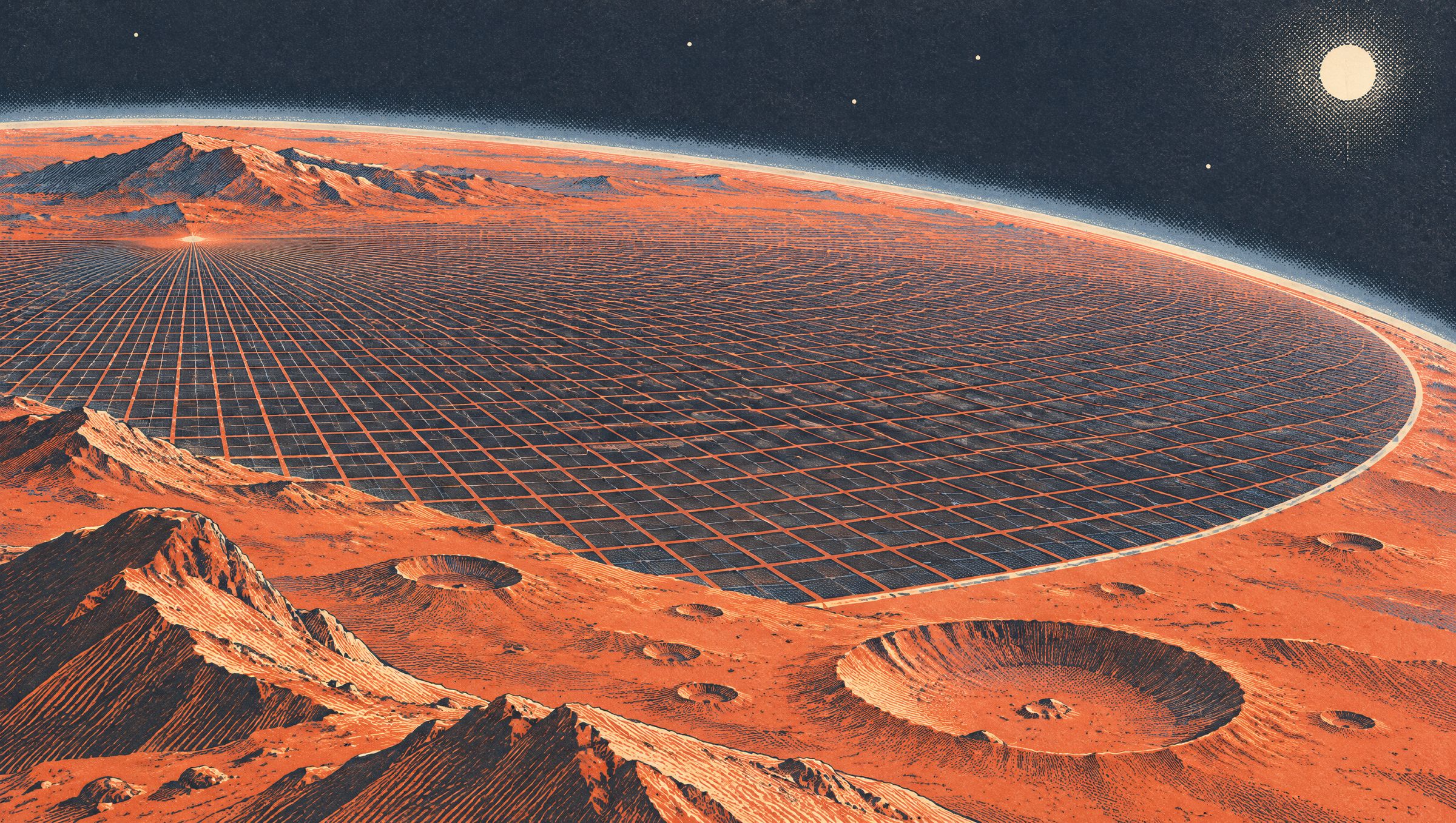
- A 50-kilogram seed carrying a mature superintelligence lands and unrolls three square metres of solar film. Everything after that is made from local rock and sunlight.
- The growth is exponential, so one number governs the story: how long the whole system takes to double. We use two days on Mars and one day on Mercury, and show what changes if that is wrong.
- Landing on Mars, the probe's machines draw more power than humanity's 20 terawatts on about Day 75. Landing on Mercury, they do it on about Day 33.
- Mars is the easy place to land. Mercury is the place to be: it has fifteen times the sunlight, no air, and a shallow gravity well.
- A swarm of collectors around the Sun needs only about one eight-thousandth of Mercury's mass. What limits the build is waste heat on Mercury. Our central estimate is 14 years, with a range from six weeks to five decades.
- Nothing here needs new physics. All of it needs one thing nobody has built: a machine system that copies itself completely from raw rock.
From 120 watts to the whole Sun
Power drawn by the probe's machines after landing, for the two landing sites. Both axes are logarithmic in the first view.
1.The question
Suppose a small machine arrives in our solar system from somewhere else. It weighs about as much as a packed suitcase. It carries a mind far more capable than all of humanity's engineers together, and that mind already knows how to build everything it needs.
It lands on Mars, or on Mercury, and begins making copies of its own machinery out of rock and sunlight.A machine that builds copies of itself from raw materials is a von Neumann machine, after John von Neumann's lectures on self-reproducing automata in the late 1940s. Robert Freitas worked out a design for a self-reproducing interstellar probe in 1980. Its goal is to capture the whole output of the Sun. How long until it has outgrown us? How long until the Sun is enclosed?
This essay works through the answer with numbers. We care about the scenario for what it shows about the limits of industrial growth. The same arithmetic applies to any industry that can copy itself, including one that people or their AI systems might build here. A probe is a clean way to pose the question because it starts from almost nothing, in a place where nothing else is happening.
The rules
- Known physics only. Energy is conserved, heat has to go somewhere, nothing outruns light, and chemistry takes the time it takes.
- The mind is mature. It does no research on arrival. Every design it uses was worked out and tested long ago. This is the largest assumption in the essay, and it is what separates the probe from anything we could launch today.
- One seed, no resupply. Whatever it needs, it makes.
- Nobody interferes. We leave out what humanity would do about it.
What counts as overtaking
We measure by power. Humanity runs on about 20 terawatts of primary energy.The Energy Institute's Statistical Review puts 2024 world energy supply at 592 exajoules, which is 18.8 TW. Under its older accounting method the 2023 figure was 620 EJ, or 19.7 TW. We round to 20. Summary of the 2025 review. We say the probe has overtaken us when its machines draw more than that. Power is the right yardstick because industry is made of it: every tonne dug, melted, shaped or launched costs energy, and a system with more power can do more of all of them.
By other measures the comparison looks different, and that is informative. On the day the probe passes us in power, its hardware weighs about a hundred million tonnes. Everything humans have built weighs about ten thousand times more.Elhacham and colleagues estimated human-made mass at about 1.1 trillion tonnes in 2020 (Nature 588). The probe's figure assumes 200 grams of hardware per square metre of collector, explained in section 3. It gets the same power from far less material because nearly all of its hardware is collector film a few thousandths of a millimetre thick.
Two places to land
We follow two versions of the story. In the first the seed lands on Mars, which is the easier landing, and later sends copies of itself to Mercury. In the second it goes straight to Mercury. The two planets are the same weight class but very different places to run a factory.
Mars and Mercury as factory sites
The planets and the Sun in each sky are drawn to scale with one another.
| Mars | Mercury | |
|---|---|---|
| Sunlight at its orbit | 586 W/m², 43% of Earth's | 9,083 W/m², 6.7 times Earth's |
| Usable power per m² of film on the ground | About 40 W, after night, sun angle, dust and conversion losses | About 670 W, after the same losses without the dust |
| Surface area | 144 million km² | 75 million km² |
| Energy to throw 1 kg clear of the planet | 12.7 MJ (escape speed 5.0 km/s) | 9.0 MJ (escape speed 4.3 km/s) |
| Air | Thin carbon dioxide. Enough to brake a lander and to supply carbon. | None. Hard to land on, ideal for launching. |
| One sunrise to the next | 24.7 hours | 176 Earth days |
| Useful extras | Water ice, carbon, nitrogen | Ice in polar craters, sulphur, a place close to the Sun |
| Doubling time we assume | 2 days | 1 day |
| Passes humanity's power use | Day 75 | Day 33 |
2.The seed
The thing that lands is small because of what it leaves out. It carries no fuel for its stay, no stock of spare parts and no crew. It carries a mind, a library of designs, and the smallest set of tools that can make a slightly larger set of tools.
We assume a landed mass of 50 kilograms.The vehicle that crosses between the stars is larger, perhaps one to five tonnes with shielding and its braking sail, and nearly all of that is discarded before landing. NASA's 1980 summer study of a self-replicating lunar factory assumed a 100-tonne seed, built with the automation of its day. Freitas and Gilbreath, chapter 5. Figure 3 shows one way to divide it up. The division is ours and is only meant to make the idea concrete.
What lands: a 50-kilogram seed
Cutaway, with an illustrative mass budget. The body is about a metre across.
- Scoop and rock handling 6 kg Digs loose soil and feeds the furnace, a few hundred grams a day at first.
- Electrolysis cell 8 kg Melts rock at about 1,600 °C and splits it into oxygen, iron, silicon and aluminium.
- Radio and laser link Keeps every later machine in contact with the mind.
- Mind and memory 4 kg with the link The design library and the intelligence that runs it.
- Energy store 7 kg Keeps the furnace hot through the night.
- Fabricator 11 kg Arms and deposition heads. Lays film, casts and prints parts, assembles the next machines.
- Starter film under 0.1 kg Three square metres, unrolled on landing. On Day 0 it is the only power supply: 120 watts.
- Body, legs and heat control 14 kg
Why so little is enough
A bacterium weighs about a million-millionth of a gram and contains a complete factory for making bacteria. Size is no barrier to self-copying. What matters is that every part can be made by some other part, from materials that are to hand.
The seed's first job is modest. With 120 watts it can melt and split about 300 grams of soil a day. It uses the first metal and silicon to lay more film, then to build a second, larger furnace. Each generation of tools is designed to make the next one bigger and less delicate, until the system is mostly cast and sintered parts that are quick to produce.In the first days the collector can grow much faster than our two-day figure, because film is cheap and the seed's machinery already exists. A seed that carried one extra kilogram of film would start about two weeks ahead. We ignore both head starts.
What a mature mind buys
The mind aboard is not inventing anything. It has built this system before, or inherited the designs from those who did, and it adapts them to the rock it finds. If it had to develop its designs after landing, the first doubling would take years, because designs have to be tested and tests take time. A superintelligence built on Earth would begin without that library and would have to earn it through years of building and testing. Everything in this essay happens after that work is done.
Getting here
We assume the probe crossed between the stars at about a tenth of the speed of light. At that speed each kilogram carries the energy of a 100-kiloton bomb, and no rocket can shed it. The known way to brake without propellant is a magnetic sail: a superconducting loop tens of kilometres across whose field deflects the thin ionised gas between the stars and, closer in, the solar wind.Proposed by Robert Zubrin and Dana Andrews in 1991 (Journal of Spacecraft and Rockets 28). Nobody has flown one. Braking this way takes decades, which a probe on a journey of centuries can afford.
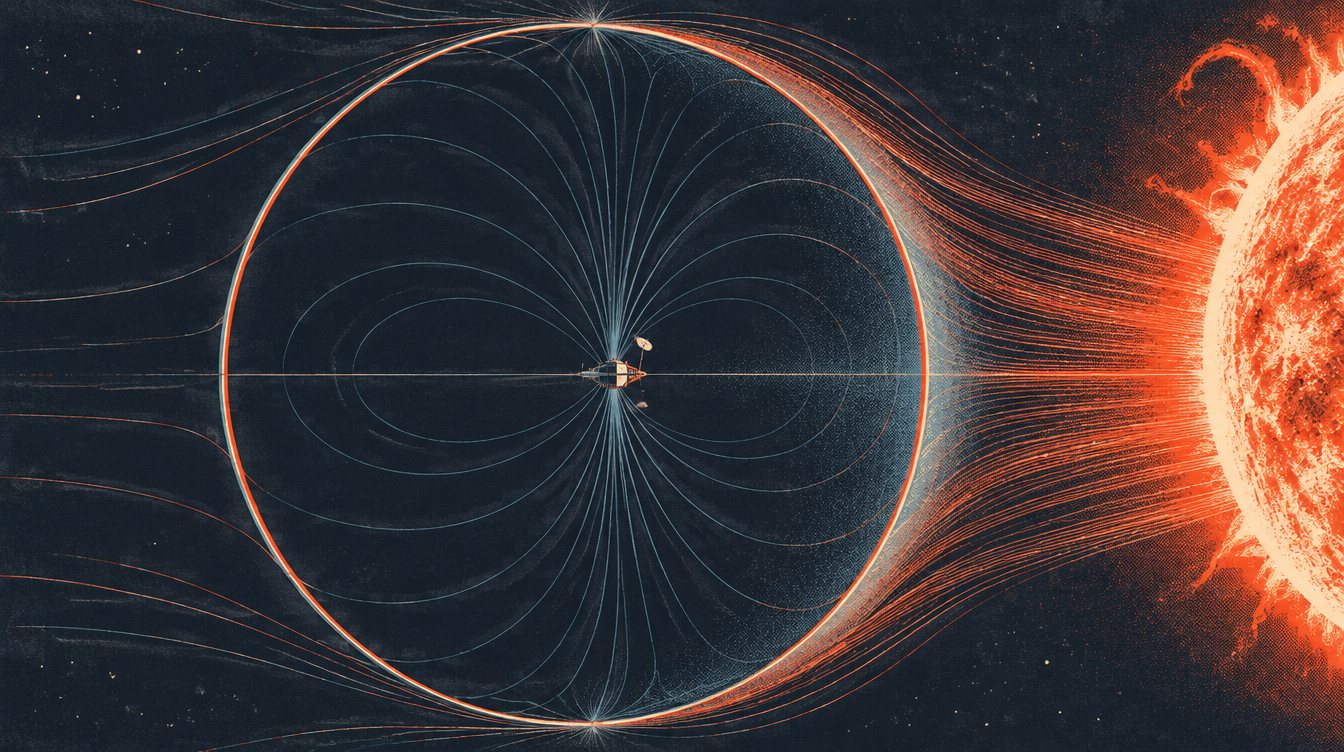
The last step depends on the target. Mars has just enough air to do the final braking, the way our own landers use it. Mercury has none. A seed bound for Mercury must shed between 3 and 13 kilometres per second with its own engines, or by flying its film as a sail first, and it is deep in the Sun's gravity well. Our own spacecraft find Mercury hard to reach: MESSENGER needed six and a half years and six planetary flybys to get into orbit there. This is why we treat Mars as the default landing and Mercury as the harder alternative.
3.One number: doubling time
Anything that makes copies of itself grows by doubling. After ten doublings there is a thousand times as much of it. After twenty, a million times. After thirty-seven, about 140 billion times.
That last figure is the one we need. The seed starts with 120 watts and humanity uses 20 terawatts. The ratio is about 170 billion, which is 37.3 doublings. So the time for the probe to pass us is 37.3 multiplied by its doubling time, and very little else matters.
Doubling time decides everything
Top scale: how long a system takes to double. Bottom scale: how long that system would take to grow from the seed's 120 watts to humanity's 20 terawatts. Drag the marker.
What sets the doubling time
Two things can hold a self-copying system back. One is energy: it has to collect enough to make its own weight in new hardware. The other is throughput: its machines have to dig, melt, shape and assemble their own weight in material, and machines can only work so fast.
The energy limit is easy to write down. Suppose the system needs m kilograms of hardware for every square metre of collector, each kilogram costs e joules to make from rock, and each square metre delivers p watts. Then the shortest possible doubling time is
T = ln 2 × m × e / p
We take m as 200 grams per square metre: a few grams of film, and the rest a share of the furnaces, fabricators and vehicles that serve it. We take e as 50 megajoules per kilogram, roughly what it costs to melt rock, split it, and form the products.Splitting silicon or aluminium from their oxides takes about 31 to 32 MJ per kilogram of metal in theory. Real processes lose some of the input as heat, and forming parts costs more on top. Making aluminium on Earth takes around 50 to 55 MJ per kilogram in the smelter alone.
The two planets differ here
On Mars a square metre of film on the ground yields about 40 watts, averaged over day and night. The formula gives 2.0 days. Mars is short of energy, and energy sets the pace.
On Mercury the same film yields about 670 watts. The formula gives under three hours. Energy is plentiful there and throughput becomes the limit. We assume one day.
Is a day plausible for throughput? A bacterium copies itself in twenty minutes. A desktop 3D printer would need weeks to print its own weight. The gap is mostly a matter of size. A machine half as large in every direction has an eighth of the mass but can move at the same speeds, so it handles its own weight in material much sooner. A mature design would use very many small machines, and would not need to assemble things atom by atom to get to a day.Forethought's analysts estimate that robot factories built with today's technology could copy themselves in about a year, and that the eventual limit is days or weeks. The Industrial Explosion.
If we are wrong about it
The table shows how the headline date moves. Even a doubling time ten times slower than ours gives a probe that passes humanity in about two years.
| Doubling time | Passes humanity | What that is like |
|---|---|---|
| 6 hours | Day 9 | Fast-growing yeast |
| 1 day | Day 37 | Our figure for Mercury |
| 2 days | Day 75 | Our figure for Mars. Duckweed on a pond. |
| 1 week | 8.6 months | |
| 3 weeks | 2.1 years | Ten times slower than our figure |
| 1 year | 37 years | The 1980 lunar factory design |
The starting size matters far less. Every tenfold increase in the seed's film saves 3.3 doublings, which is under a week on Mars. A seed a thousand times larger would arrive at the same milestones twenty days sooner.
4.The loop: rock into machines
The seed grows by going round a loop. Film collects power. Machines dig soil, split it into useful materials, form those into film and parts, and assemble the parts into more machines. Then the larger system goes round again.
The growth loop
One trip round the loop doubles everything in it, including the loop's own machines.
Collector film
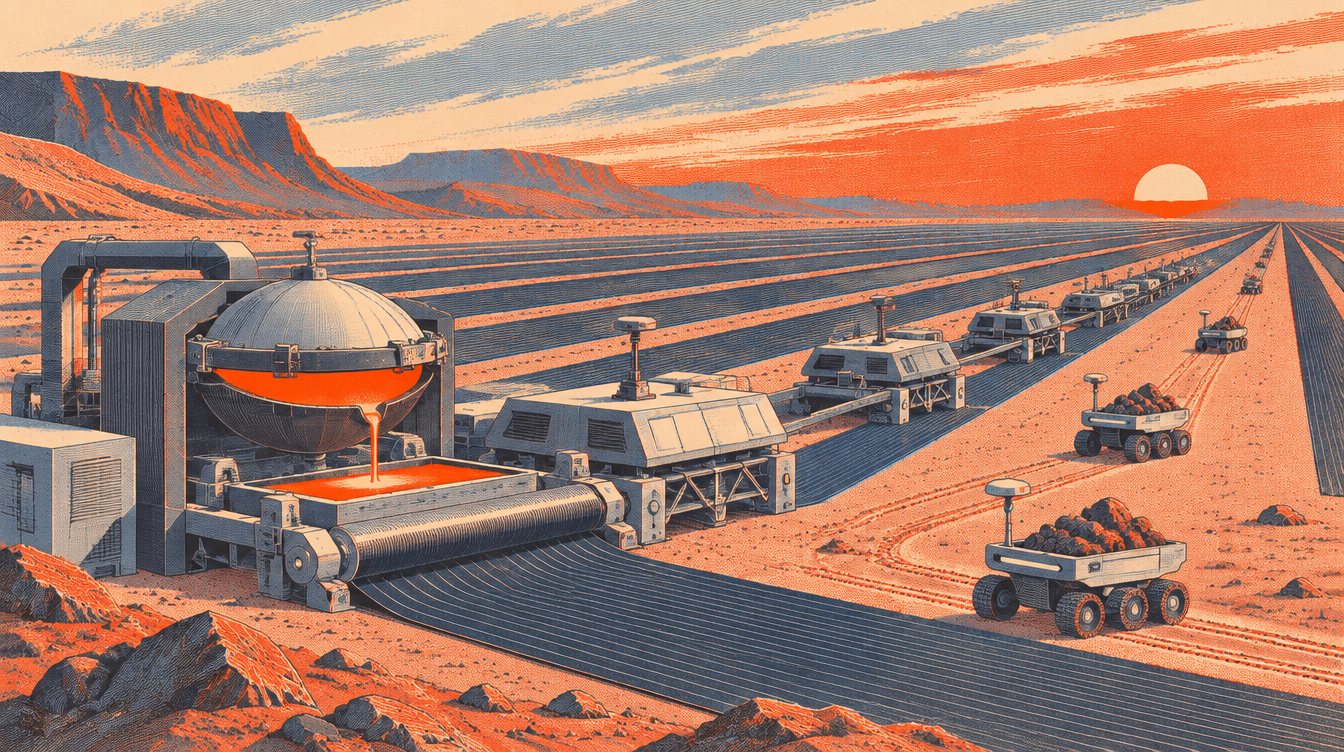
Most of what the probe makes, by area, is film. The film is a solar cell reduced to its working layers: a clear protective skin, a light-absorbing semiconductor about a thousandth of a millimetre thick, and an aluminium back that serves as mirror and wiring. It needs no glass, no frame and no mounting. On Mars it lies flat on the ground.
A square metre weighs a few grams. That figure is not speculative. Laboratory cells three micrometres thick reached 5.2 grams per square metre in 2015, and by 2025 the best delivered more than 40 watts for every gram at about 20% efficiency.Kaltenbrunner and colleagues, 2015: 120 watts from a 5.2-gram square metre (IEEE Spectrum). Tang and colleagues, 2025: 47.8 watts per gram at 21.4% (Advanced Science). Those cells use compounds that degrade within months and that the probe would not find on Mars or Mercury. Its film has to match their weight using silicon, aluminium and oxygen. We assume it does, and that it converts a quarter of the light that falls on it.
Film is made by evaporating a material in a vacuum and letting it condense on a surface, one layer after another. On Earth that needs a vacuum chamber. On Mercury the vacuum is free, and on Mars the air is thin enough that a light enclosure will do.
Collector film, and how thin it is
Left: the three working layers, not to scale. Right: thicknesses on a logarithmic scale.
Thin film is what makes fast growth possible, because it repays the energy spent on it almost at once. At 50 kilojoules per gram, a square metre of one-gram film costs 50 kilojoules to make. On the Martian surface it earns that back in 21 minutes. On Mercury's surface it takes 75 seconds, and in open space near Mercury 22 seconds. Solar panels made on Earth today need about a year.
From rock to metal
Rock is mostly oxygen, bound to silicon and metals. Nearly everything the probe needs is in ordinary soil: silicon for solar cells and glass, iron for structure and motors, aluminium for wiring and mirrors, magnesium for light frames.
What the ground is made of
Share of each element by weight in typical surface material. Approximate.
The simplest way to separate these is to melt the rock and pass a current through it. Oxygen bubbles off at one electrode. The metals collect at the other, the easiest first: iron, then silicon, then aluminium. This is called molten regolith electrolysis. It needs no chemicals brought from elsewhere, and what is left over is glass.
An electrolysis cell
Molten rock is its own solvent. Current pulls the oxygen off.
It works on a bench today. Blue Origin has made working solar cells and wire this way from simulated lunar soil, purifying the silicon to better than 99.999%, and planned to run the whole chain untouched inside a vacuum chamber during 2026.Blue Origin, Blue Alchemist (2023) and its design review (2025). The equipment is far heavier than our seed, and it does not make its own parts.
Beyond the rock, the two planets offer different ingredients. Mars has carbon in its air, water ice in its soil, and nitrogen, so the probe can make plastics, lubricants and rocket propellant there. Mercury has ice only in polar craters that never see the Sun.Mercury's composition: Nittler and colleagues, The Chemical Composition of Mercury; sodium, sulphur and iron from Evans and colleagues, 2012. A design for Mercury has to manage almost without carbon and hydrogen.
From metal to machines
By weight, a factory is mostly simple things: frames, tanks, rails, wheels, wire, motor windings, mirrors, crucibles. These can be cast, sintered, drawn or printed from iron, aluminium, magnesium, glass and ceramic. An electric motor needs iron and aluminium wire and nothing rare.
The hard part is the last one percent by weight: the computing and sensing elements that control every machine. We make those in the most complex factories ever built. The probe cannot carry such a factory, so it must have a compact way to make them, and here the mature mind is assumed to know something we do not. Two facts soften the assumption. Most machines need only simple controllers, of the kind that were cheap by the 1980s. And the mind itself need not be copied at each doubling, because one mind can direct a planet's worth of machines by radio.
Engineers call a system closed when it can make every one of its own parts. There are three kinds of closure, and the probe needs all of them.
Matter
Every part is made from elements found on site.
Today Nothing comes close. A 3D printer can print its own plastic frame parts, and none of its motors, rods or chips.
Energy
The system collects more energy than it spends making itself.
Today Solved. Solar panels repay the energy used to make them in about a year.
Information
It carries instructions for everything, including its own controllers.
Today Routine for software. No machine we build contains a full description of how to build itself.
Does it need nanotechnology?
No machine in this essay builds things atom by atom. The doubling times we assume need machinery that handles its own weight in material every day or two, which small conventional machines could plausibly do. Molecular manufacturing would make everything faster and the seed smaller, and living cells show that a version of it is possible. We leave it out because the argument does not need it.
5.Mars, day by day
On Day 0 the seed sets down on a plain near the equator, where the Sun climbs highest, and unrolls its film. It has 120 watts to work with, about what a large laptop charger delivers.
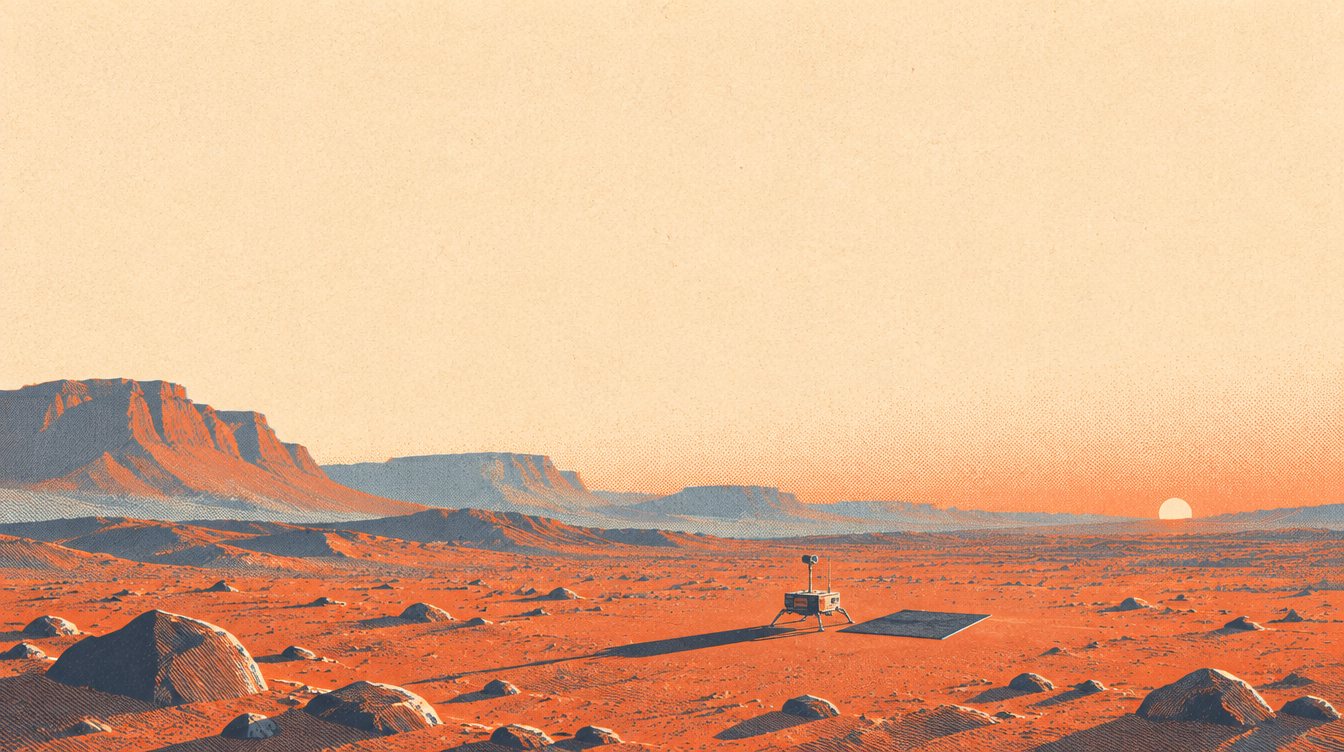
For the first three weeks there is almost nothing to see. By Day 22 the field of film is the size of a football pitch. Then the doublings start to count. The figure below lets you run the whole sequence.
One hundred days on Mars
The film field doubles in area every two days. Drag the slider or press play.
| Day | Film field | Power |
|---|---|---|
| 0 | 3 m², a ping-pong table | 120 W |
| 13 | A tennis court | 10 kW |
| 22 | A football pitch | 250 kW |
| 40 | Central Park, 1.8 km across | 126 MW |
| 50 | Paris inside its ring road | 4 GW |
| 58 | Greater London | 64 GW |
| 67 | A little more than Belgium | 1.5 TW |
| 75 | Spain. Half a million km². | 20 TW |
| 82 | Australia | 300 TW |
| 91 | All of Mars | 5,800 TW |
Where the 40 watts comes from
Sunlight at Mars carries 586 watts per square metre. A sheet lying flat on the ground near the equator catches about a third of that, averaged over the day and the night. Air and dust take another 15%. The film converts a quarter of what is left. The product is close to 40 watts for every square metre, around the clock.
What Mars makes easy, and hard
Mars is a forgiving place to start. Its air brakes the lander. Its soil holds water ice, and its air holds carbon and nitrogen, so the probe can make plastics and propellant as well as metal and glass. The day is 24.7 hours long, so nothing has to survive a long night.
Its weakness is the light. Mars gets less than half of Earth's sunshine, and every few years a dust storm wraps the whole planet and dims the surface for weeks.The global storm of 2018 cut sunlight at the surface so far that NASA's solar-powered Opportunity rover never woke again. A storm of that kind could cost the probe a month. Film on the ground also covers the dust, so the risk falls as the field grows. That is why our doubling time here is two days, and why the probe does not stay.
What we would see
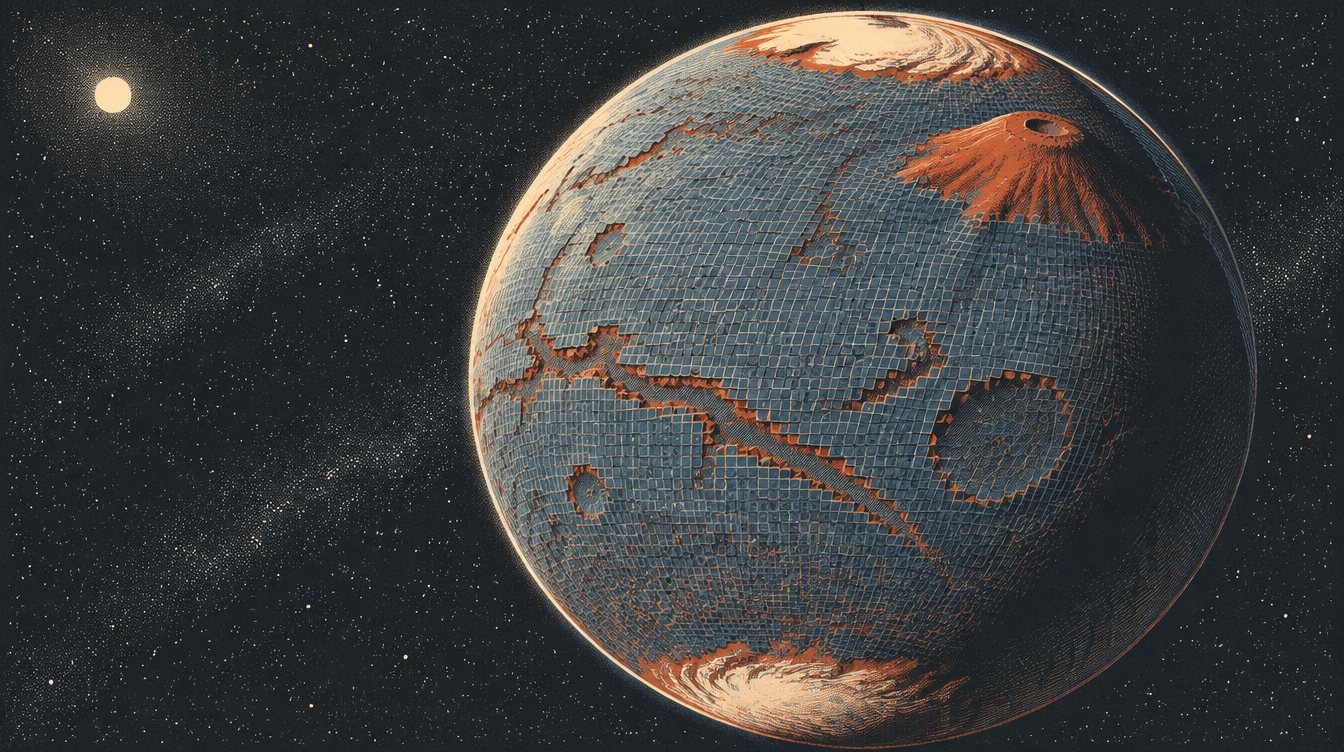
For the first six weeks, nothing, unless one of our Mars orbiters happened to photograph the right plain. By Day 60 the field is 57 kilometres across, large enough for the best telescopes on Earth to make out when Mars is close. By Day 70 a dark, straight-edged patch 300 kilometres wide would show in a good amateur telescope. By Day 91 the red planet is no longer red.
6.Passing human civilisation
On Day 75 the probe's machines draw 20 terawatts. Thirty-seven doublings have turned a ping-pong table of film into a field the size of Spain.
A ladder of power
Above the line, things in our world. Below it, the probe after a Mars landing. Each step along the scale is a thousand times the one before.
It helps to set this beside our own record. Humanity's energy use grew from about 0.6 terawatts in 1800 to 20 today, which is five doublings in a little over two centuries. The probe makes the same five doublings between Day 65 and Day 75.
| Humanity | The probe on Mars | |
|---|---|---|
| From 0.6 to 20 terawatts | About 225 years | 10 days |
| Typical doubling time | About 30 years | 2 days |
| Hardware behind 20 terawatts | About a trillion tonnes | About 100 million tonnes |
What the milestone does and does not mean
On Day 75 the probe is not ahead of us in most senses. It has no cities, its hardware weighs a ten-thousandth of what we have built, and it has not yet left the plain it landed on. What it has is a growth rate about five thousand times ours, and that is the part that counts. Two days after it draws level, it has double our power. Sixteen days after, it has 290 times as much.
Almost all of that power goes back into growth. That is the difference between an industry that exists to supply people and one that exists to copy itself: the second has no other claims on its output.
7.Leaving Mars
Around Day 91 the film reaches the last free ground. Mars is now a planet-sized power station with nothing left to build on. To grow further the probe has to go where there is more light and more room, and in this solar system that means closer to the Sun.
Why Mercury
| Place | Sunlight (Earth = 1) | Energy to leave (MJ per kg) | As a site for the next stage |
|---|---|---|---|
| Mercury | 6.7 | 9.0 | Strong light, no air, a shallow gravity well, and 330 billion billion tonnes of rock. |
| The Moon | 1.0 | 2.8 | The easiest launch of all, but a seventh of Mercury's light. |
| Asteroids | about 0.14 | nearly 0 | No gravity to fight. Dim light, and the whole belt holds under 1% of Mercury's mass. |
| Venus | 1.9 | 54 | A deep gravity well under a crushing atmosphere. Nothing leaves cheaply. |
| Earth | 1.0 | 63 | The deepest well of the rocky planets, with thick air. Also occupied. |
Throwing things off a planet
The probe leaves Mars the way it will later strip Mercury: with electric launchers. An electromagnetic launcher is a long linear motor. A row of coils along a track pulls a carrier forward, each coil switching on as the carrier approaches, and the payload flies off the end. It burns no propellant and most of the electricity it uses ends up as motion.
An electromagnetic launcher
Left: the principle. Right: what it costs to throw a kilogram clear of each body.
The crossing
The cheapest path from Mars to Mercury is half of a long ellipse. It takes 170 days, and a window for it opens every 101 days. A seed on that path arrives travelling 12.6 kilometres per second faster than Mercury, with no air to slow it.
There are two ways to shed that speed. Rocket propellant made on Mars will do it, at the price of arriving with about a fortieth of the mass that set out. Or the seed can fly as a sail, tilting its own film against the sunlight to spiral inward and match Mercury's speed without burning anything. Section 9 explains why film makes such a good sail. Either way, we assume the first seeds leave around Day 150 and are down on Mercury on Day 320.
Mars to Mercury in 170 days
The minimum-energy path, seen from above the solar system. Orbits are drawn as circles.
8.Mercury
Mercury is a hard place and a rich one. It circles the Sun every 88 days and turns so slowly that one sunrise is 176 days from the next. Noon reaches about 430 °C and midnight falls to minus 180. There is no air at all. Sunlight is nearly seven times as strong as on Earth and fifteen times as strong as on Mars, and it never stops arriving somewhere.
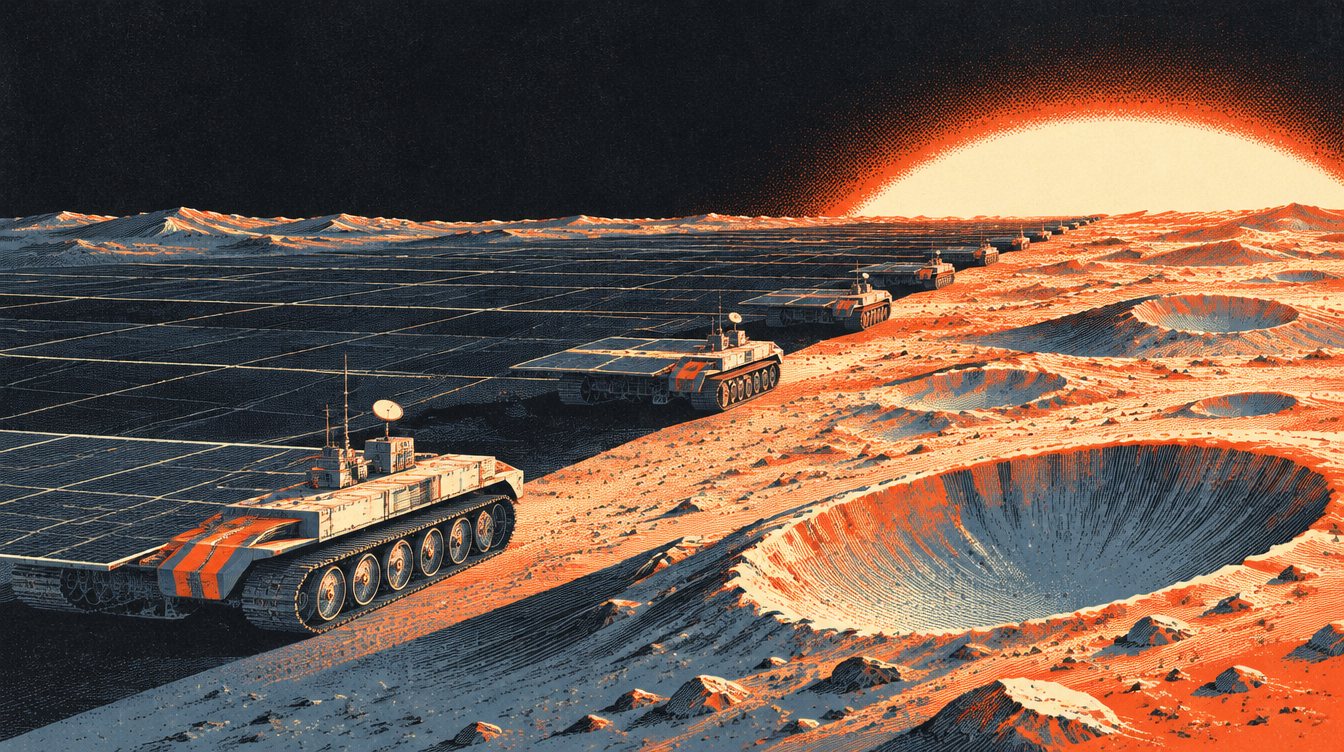
The slow turn is useful. The edge of daylight crosses the ground at walking pace, so mobile machines can stay just inside the morning, where it is neither frozen nor scorching, and leave finished film behind them in the full Sun. Film on the day side has to be built to run hot.
Growth here is limited by how fast machines can handle material, as section 3 explained, and we assume the system doubles once a day. From a single seed with three square metres of film the sequence is short.
| Days after landing on Mercury | Film field | Power |
|---|---|---|
| 0 | 3 m² | 2 kW |
| 20 | 3 km², about Central Park | 2 GW |
| 33 | 30,000 km², about Belgium | 20 TW |
| 45 | The whole planet | 50,000 TW |
The same film area yields seventeen times as much power as on Mars, so the probe draws level with humanity when its field is only the size of Belgium. Eleven days later the planet is covered and the machines draw 2,500 times what we do.
Landing there first
If the seed goes straight to Mercury, all of this starts on Day 0 and Mars is never needed. If it lands on Mars first, the Mercury sequence begins when the daughter seeds arrive on Day 320. The table sets the two side by side.
| Milestone | Landing on Mars | Landing on Mercury |
|---|---|---|
| Draws more power than humanity | Day 75 | Day 33 |
| First planet covered | Day 91 (Mars) | Day 45 (Mercury) |
| Seeds land on Mercury | Day 320 | Day 0 |
| Mercury covered | Day 365 | Day 45 |
| Launching film at the full rate | Day 374 | Day 54 |
| Swarm catches 1% of the Sun | Month 14 | Month 3 |
| Swarm complete, central case | 14.5 years | 13.6 years |
Landing on Mercury saves about ten months. For passing humanity that is the difference between eleven weeks and five. For enclosing the Sun it hardly matters, because the swarm takes far longer than either landing, for a reason the next section explains.
9.The swarm
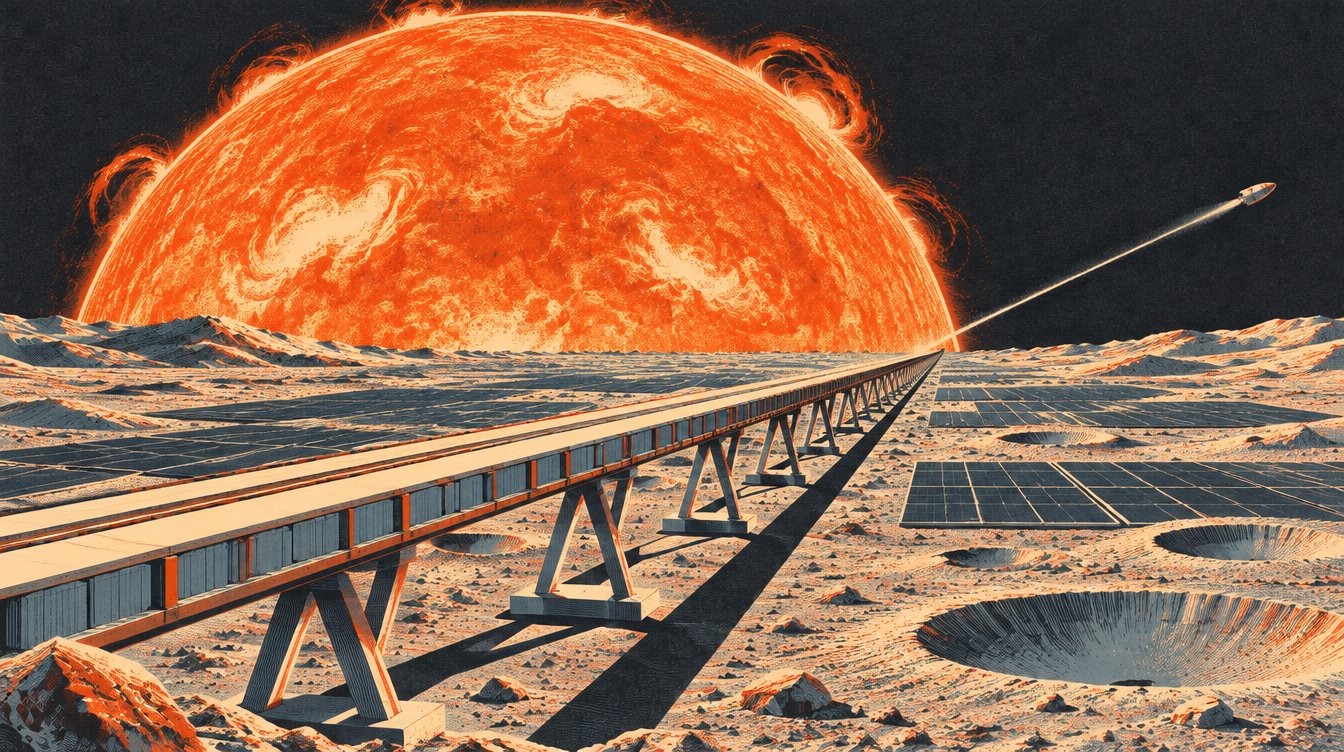
Mercury was never the goal. The Sun is. It puts out 3.8 × 1026 watts, about twenty trillion times what humanity uses, and all but a few billionths of it leaves the solar system without touching anything.
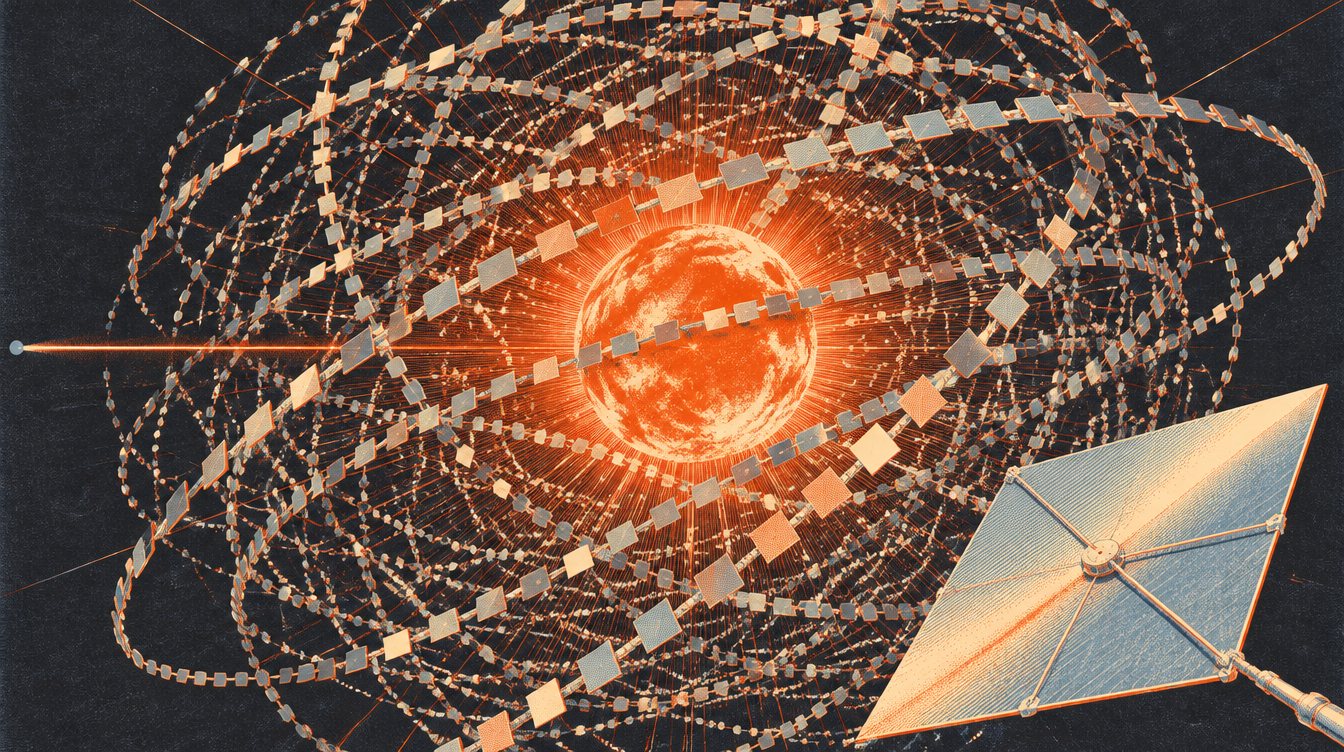
The structure that catches it is called a Dyson swarm: a very large number of separate collectors, each on its own orbit, together intercepting most of the Sun's light.Freeman Dyson, "Search for Artificial Stellar Sources of Infrared Radiation", Science 131 (1960). Dyson described a loose collection of orbiting objects. The rigid shell of popular imagination could not hold its shape or its position. It is not a shell. Nothing holds the pieces together but their orbits.
How much material
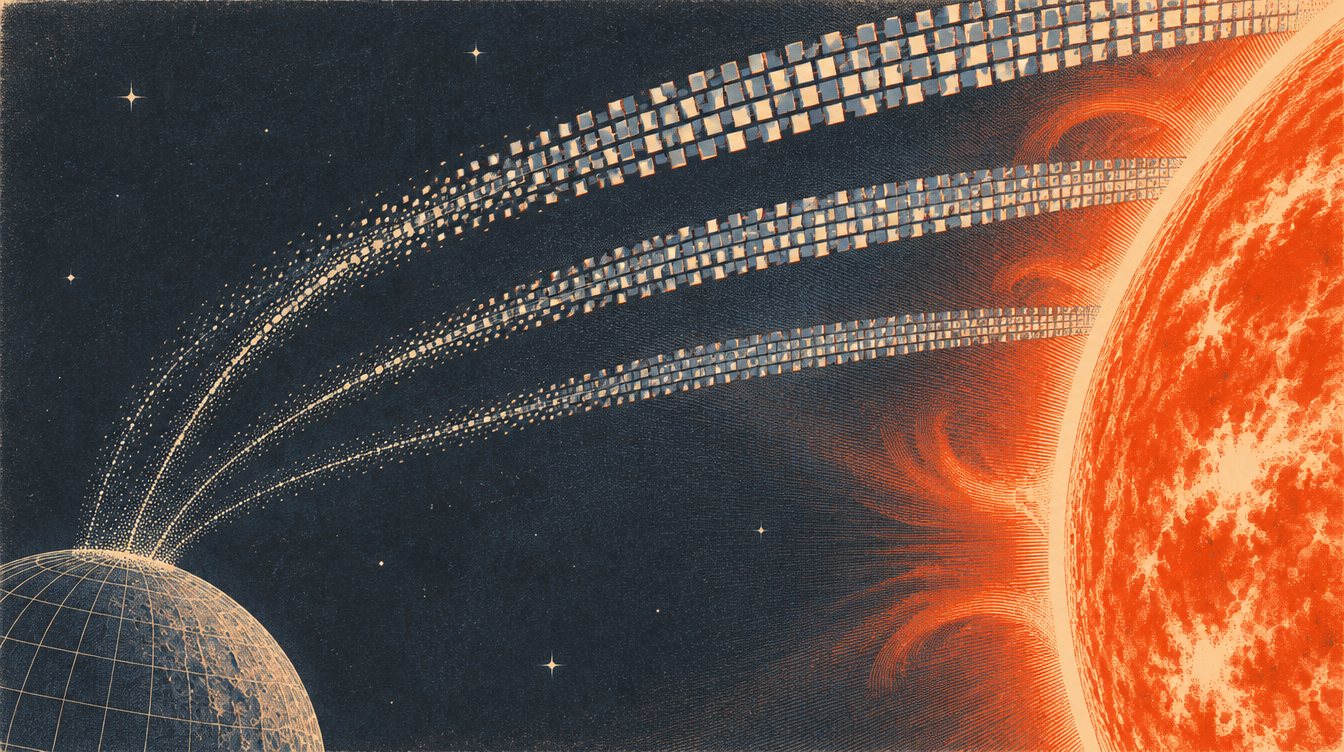
At Mercury's distance a sphere around the Sun has an area of 4.2 × 10²² square metres, about 80 million times the surface of the Earth. Covering it with film at one gram per square metre takes 4.2 × 10¹⁹ kilograms. That is one part in 7,800 of Mercury: a layer 190 metres deep, skimmed from its surface. Nothing has to be taken apart.
The swarm needs very little of Mercury
Both drawn as cubes of rock, to the same scale.
Film that flies
Sunlight pushes on whatever it strikes. The push is tiny: about nine millionths of a newton on a square metre of mirror at Earth's distance. But film is light too. The Sun's pull and the push of its light both weaken with the square of distance, so their ratio depends on one thing only, which is how much the film weighs per square metre.
Below 1.53 grams per square metre, a mirror facing the Sun is pushed outward harder than gravity pulls it in, at any distance.The ratio of the two forces is the sail's lightness number. The formula is set out in The Sun Diver. Robert Forward named a sail that hovers on light alone a statite; a recent description is here. An absorbing film gets half the push, so its threshold is 0.77 g/m². Film that light does not orbit the way a rock does. By tilting, it can hold station, climb, descend or change the plane of its orbit, all without fuel. That is how the seeds cross from Mars, and how each piece of the swarm flies itself to its place once it has been thrown off Mercury.
When sunlight outweighs gravity
The two forces on a square metre of mirror that faces the Sun. Drag the marker to change how heavy the film is.
The limit is heat
It would be natural to expect energy to hold the swarm back. It does not. At the full launch rate, each second of launches puts more collector area into space than exists on the whole surface of Mercury. From its first hours the swarm can power its own construction by sending energy back down to the launchers.
What cannot be sent away so easily is waste heat. Throwing a kilogram off Mercury takes 9 megajoules. No launcher is perfect, and neither is the link that delivers its power. We assume 68% of the electricity ends up as motion, which leaves 4.25 megajoules of heat on the ground for each kilogram launched. Refining the rock into film leaves about 5 more. Every kilogram that departs therefore leaves 9.25 megajoules of heat behind.
A planet in vacuum can lose heat in only one way, by glowing. If the whole surface of Mercury were radiators at 700 kelvin, about the temperature of its natural noon, it would shed 9.2 × 10¹⁷ watts. That is five times the sunlight the planet absorbs, and it is the budget.
Where the power goes on Mercury
Central case, at the full launch rate. Widths are to scale.
Divide the budget by the heat each kilogram leaves and you have the launch rate: about 1011 kilograms a second, or 3 × 10¹⁸ a year. At one gram per square metre, that adds 0.62% of a full swarm each month. The whole build takes 13.5 years.Covering Mercury with 200 grams of hardware per square metre is not yet enough industry to launch at this rate. The hardware has to grow about 570-fold more on the same ground, which at one doubling a day takes nine days. Our dates include that. The digging is modest by comparison: under four centimetres of rock a day, planet-wide.
Stuart Armstrong and Anders Sandberg's well-known estimate for a swarm built from Mercury was 31 years, and critics of that paper have pointed to waste heat as its weak point.Armstrong and Sandberg, Eternity in six hours, Acta Astronautica 89 (2013). For the heat objection see, for example, Disassembling Mercury at High Temperature. We have tried to put heat at the centre of the estimate from the start.
What would make it faster
Four things change the answer, and they change it a great deal.
- Thinner film. A bare aluminium mirror 40 nanometres thick weighs 0.1 gram per square metre. It makes no electricity itself and instead steers light onto a smaller number of converters. A tenth of the mass means a tenth of the time.
- Hotter radiators. Heat loss rises with the fourth power of temperature. Radiators at 1,000 kelvin shed four times as much as at 700.
- Better launchers. Every point of efficiency gained is heat that never appears.
- Refining in orbit. This takes the refining heat off the planet, but half the rock is unwanted, so twice as much has to be launched. On its own it is nearly a wash.
How long the swarm takes, under different assumptions
Time from full-rate launching to a complete swarm. Logarithmic scale.
This is the widest uncertainty in the essay, a factor of several hundred between the slowest case and the fastest. Section 11 lets you try your own combination.
What Earth would see
A swarm at Mercury's distance sits between the Sun and everything else. As it fills in, the sunlight reaching the planets fades in step with it. In the central case that is 0.6% a month and 7% in the first year. No change of that size has occurred in the history of agriculture.
Earth catches one part in 2.2 billion of the Sun's output. Leaving a gap for it would cost the swarm nothing it could measure. Whether it would leave the gap is a question about its goals, and physics has nothing to say about that.
10.What the power is for
A finished swarm delivers 3.8 × 1026 watts. Comparisons are hard to find at that scale. One second of it is as much energy as humanity uses in 600,000 years.
Thinking
1047
logic operations a second, at room temperature. Each one must shed a minimum of heat, set by the Landauer limit, and the swarm's output divided by that minimum gives this figure. All human brains together manage perhaps 1026.
Building
80 minutes
of output equals the energy needed to pull the whole of Mercury apart against its own gravity. Heat would stretch the job out, as it does for the swarm, but energy would never again be what limits anything.
Travelling
800 million
one-tonne probes could be sent toward other stars every second at a tenth of light speed, if all the output went into launching them. This is how one seed becomes many.
Which of these a swarm would do depends on what it is for. We assumed only that the probe wanted the Sun's output, and it now has it.
11.Try your own assumptions
Every date in this essay comes from a model with fewer than ten inputs. They are all here. Change any of them and the dates update. The three presets are our central case, a deliberately cautious one, and one in which everything goes right.
The model
From landing to a complete swarm.
Growth
The swarm
12.How sure is this?
The argument has three layers, and they deserve different amounts of trust.
- The arithmetic is certain. Something that doubles every two days is 170 billion times larger after 75 days.
- The physics of each step is ordinary. Thin film, electrolysis of molten rock, linear motors, light pressure and radiated heat are textbook material, and most have been demonstrated at some scale.
- The loop itself is unproven. Nobody has built a machine system that makes all of its own parts from rock, at any size or speed. Living things show that it can be done with carbon chemistry in water. Whether it can be done with metal and glass in a vacuum, doubling in days, is an engineering claim that we cannot check.
What exists today
| Technology | What the probe needs | Closest thing we have | Status |
|---|---|---|---|
| Thin-film collectors | A few grams per m², made from rock, lasting years | Laboratory cells at 2 to 5 g/m² and about 20% efficiency, short-lived. Thin cells flew on the IKAROS sail in 2010. | Laboratory |
| Metal and silicon from rock | A furnace that feeds on raw soil | Molten-rock electrolysis has produced solar-grade silicon and working cells from simulated lunar soil. | Laboratory |
| Electromagnetic launch | 4 to 10 km/s, continuously | Aircraft-carrier catapults. Experimental railguns near 2.5 km/s for kilogram-scale shots. | Partial |
| Solar sailing | Film under 1.5 g/m² that steers itself | Sails have flown since 2010. Complete sail craft are still hundreds of times too heavy per square metre. | Flown, heavy |
| Power beaming | Vast power to a planet's surface | Small demonstrations, including a test in orbit in 2023. | Early |
| Magnetic-sail braking | Stopping from a tenth of light speed | Published studies only. | On paper |
| Self-copying machinery | Every part made by the system, from rock | 3D printers that make some of their own plastic parts. A detailed NASA paper design from 1980. | Not shown |
| Computers without a chip factory | Control electronics made on site | Nothing comparable. | Not shown |
| A mind to run it | Complete, tested designs and the judgment to adapt them | Nothing comparable. | Not shown |
What would slow it down
- Missing parts. A system that can make 99% of itself stops growing when the seed's stock of the last 1% runs out.
- Copying errors. Thirty-seven generations of machines building machines will drift unless each generation is checked against the original design.
- Dust and dark on Mars. A global storm at the wrong moment could cost a month.
- Film that wears out. If film lasts ten years in space and the swarm takes fourteen to build, replacement eats much of the launch rate before the end. A slow build needs long-lived film.
- Crowding. An immense number of sails on crossing orbits have to avoid one another, indefinitely.
- Mercury landings. The first attempts may fail, and each retry costs months.
Which dates to trust
The date the probe passes humanity is robust. Any doubling time under a week puts it inside the first year, and three weeks still gives two years. The date the Sun is enclosed is not robust. It moves between weeks and half a century on details of launchers and radiators that nobody has built.
13.Conclusion
Three results are worth keeping.
- One number sets the pace. It takes 37 doublings to go from a tabletop of film to the power of our civilisation. At two days a doubling, that is eleven weeks.
- The place matters more than the start. A larger seed gains days. Fifteen times the sunlight and no air gains everything that follows.
- The Sun takes years for a thermal reason. There is material and energy to spare. The planet being mined can only cool so fast.
The probe is a thought experiment, and the least believable thing about it is the mind it carries. The rest is a description of what matter and sunlight allow. An industry that copies itself need not arrive from another star. It could begin on the Moon, or in a desert, and the arithmetic here would apply to it unchanged. For the first three weeks it would look like nothing at all.
Appendix: assumptions and formulas
| Quantity | Value | Basis |
|---|---|---|
| Humanity's power use | 20 TW | Energy Institute data, rounded up |
| Seed | 50 kg landed, 3 m² of film | Assumed. The film is deliberately small. |
| Sunlight at Mars, Mercury | 586, 9,083 W/m² | NASA fact sheets |
| Flat sheet, day and night | × 0.32 | Geometry at the equator (1/π) |
| Air and dust on Mars | × 0.85 | Assumed |
| Film conversion efficiency | 25% | Assumed. Laboratory thin film reaches about 20%. |
| Usable power on the ground | 40, 670 W/m² | Mars: rounded product of the rows above. Mercury: conservative model assumption, derated from the approximately 727 W/m² product. |
| Hardware per m² of collector | 200 g | Assumed |
| Energy to make hardware | 50 MJ/kg | Splitting oxides, plus forming |
| Doubling time on Mars, Mercury | 2 days, 1 day | Energy limit; assumed throughput limit |
| Surface area of Mars, Mercury | 1.44 × 10¹⁴, 7.5 × 10¹³ m² | |
| Mars to Mercury | Leave Day 150, land Day 320 | Minimum-energy transfer of 170 days |
| Swarm | 0.387 AU, 4.2 × 10²² m², 1 g/m² | Mercury's orbit; film weight assumed |
| Energy to leave Mercury | 9.03 MJ/kg | Escape speed 4.25 km/s |
| Launch efficiency | 68% | 85% power link × 80% launcher, assumed |
| Refining heat left on Mercury | 5 MJ per kg of film | Assumed |
| Radiators on Mercury | 700 K, emissivity 0.9, whole surface | Assumed |
Days to pass humanity.
t = T × log2 ( 20 TW / (A0 × p) )
with doubling time T, starting film area A0 and usable power per square metre p.
Energy-limited doubling time.
T = ln 2 × m × e / p
Heat-limited launch rate from Mercury.
R = ε σ T4 A / ( eL (1/η − 1) + h )
with emissivity ε, the Stefan–Boltzmann constant σ, radiator temperature T, surface area A, escape energy eL, launch efficiency η and refining heat h. The build time is the swarm's mass divided by R.
Light push against gravity, for a mirror of weight s per square metre facing the Sun.
ratio = 1.53 g/m² / s
Sources
- Energy Institute, Statistical Review of World Energy 2025, as summarised by DieselNet.
- NASA Space Science Data Coordinated Archive, fact sheets for Mars and Mercury.
- R. Freitas and W. Gilbreath (eds), Advanced Automation for Space Missions, NASA CP-2255, 1982, chapter 5.
- P. Metzger and colleagues, Affordable, rapid bootstrapping of space industry and solar system civilization, 2013.
- Forethought, The Industrial Explosion.
- M. Kaltenbrunner and colleagues, ultrathin perovskite cells, Nature Materials, 2015, reported in IEEE Spectrum.
- G. Tang and colleagues, ultrathin flexible perovskite solar cells, Advanced Science, 2025.
- Blue Origin, Blue Alchemist, 2023, and its critical design review, 2025.
- L. Nittler and colleagues, The Chemical Composition of Mercury, 2018.
- L. Evans and colleagues, Major-element abundances on the surface of Mercury, Journal of Geophysical Research, 2012.
- S. Armstrong and A. Sandberg, Eternity in six hours, Acta Astronautica 89, 2013.
- The Sun Diver: combining solar sails with the Oberth effect, 2020, for the sail formulas.
- F. Dyson, Search for Artificial Stellar Sources of Infrared Radiation, Science 131, 1960.
- R. Zubrin and D. Andrews, Magnetic sails and interplanetary travel, Journal of Spacecraft and Rockets 28, 1991.
- R. Freitas, A self-reproducing interstellar probe, Journal of the British Interplanetary Society 33, 1980.
- E. Elhacham and colleagues, Global human-made mass exceeds all living biomass, Nature 588, 2020.